
Welcome to New Faculty
Leah Frederick joined the department as Assistant Professor this fall, and Karin Buer was promoted to Assistant Teaching Professor. Their pedagogy and fields of research broaden the department’s continued support of all CU graduate and undergraduate students.
The Hexatonic Triad Cube
In mathematical music theory, musical objects (e.g., notes, rhythms, scales, or chords), are often organized in musically meaningful spatial arrangements often called musical spaces. For instance, pitches can be arranged on a one-dimensional number line, and the conventional musical staff can be understood as a two-dimensional space, where the vertical dimension represents pitch and the horizontal dimension represents time. Here, we’ll explore the structure of one of the foundational spaces in geometric music theory: the hexatonic triad cube.1

Each one of the cube’s eight vertices represents a different triad: 3 major triads (C, E, and A♭); 3 minor triads (c, e, and g♯); and 2 augmented triads (C aug and B aug). If we assume enharmonic equivalence, then this collection of triads uses only six notes {B, C, D♯, E, G, A♭}, a set known as the hexatonic collection.
In this cube, the edges connect triads that are related by a single semitone. For example, if we play a C augmented triad and move the E down by half step to E♭, then the triad becomes an A♭ major triad. We can model this musical gesture as a path down the back right edge of the cube:
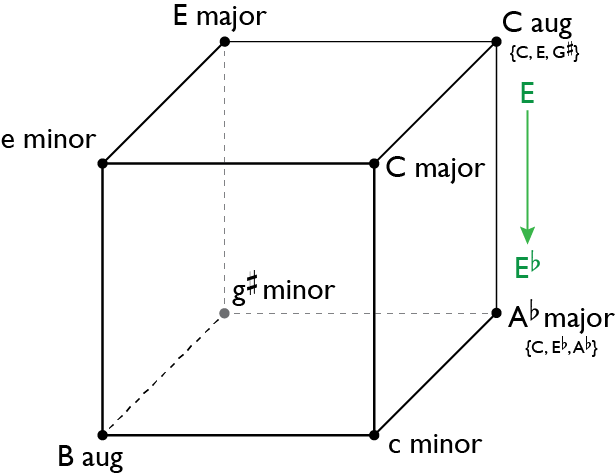
Notice that all pairs of triads that are aligned vertically in the cube are related by a move from E to D♯/E♭:
Similarly, moving from left to right represents a stepwise ascent from B to C, and moving from front to back represents a move from G to G♯/A♭:
Once we construct a musical space like this one, we can ask new questions: What musical properties are shared by the triads on each face of the cube? How many distinct triadic cubes can we construct? Can we expand this space to include other three-note chords that are not triads?
In the subfield of geometric music theory2, a chain of four cubes—a graph called “cube dance”—winds through the center of the 3-voice OP-space, a musical space that depicts voice-leading relationships between all three note chords.3 Notice that the top and bottom cubes are the same, illustrating how the space twists and connects into a loop like a three-dimensional version of a Möbius strip:

References and further reading:
Cohn, Richard. 1998. “Introduction to Neo-Riemannian Theory: A Survey and Historical Perspective.” Journal of Music Theory 42 (2): 167–80.
Cohn, Richard. 2000. “Weitzmann’s Regions, My Cycles, and Douthett’s Dancing Cubes.” Music Theory Spectrum 22 (1): 89–103.
Douthett, Jack and Peter Steinbach. 1998. “Parsimonious Graphs: A Study in Parsimony, Contextual Transformations, and Modes of Limited Transposition.” Journal of Music Theory 42 (2): 241–63.
Hook, Julian. 2023. Exploring Musical Spaces: A Synthesis of Mathematical Approaches. New York: Oxford University Press.
Tymoczko, Dmitri. 2011. A Geometry of Music: Harmony and Counterpoint in the Extended Common Practice. New York: Oxford University Press.
- The hexatonic triad cube was first proposed by Jack Douthett; see Douthett and Steinbach 1998. Hook 2023 uses the hexatonic triad cube to connect several branches of mathematical music theory; see especially pp. 79–87 and pp. 388–404. ↩︎
- Some of the foundational publications in the area of geometric music theory are Callender et al. 2008 and Tymoczko 2011. ↩︎
- For more details on the 3-voice OP-space, see Tymoczko 2011, pp. 85–93 and Hook 2023, pp. 394–404. ↩︎
– Leah Frederick
Department Updates
Faculty Activities
Mark Arnett is teaching an upper division analysis course covering American popular music and piloting a fully online and asynchronous basic music theory course for students who are not music majors. In addition to teaching, Mark has returned to a set of piano compositions for future release.
Karin Buer is working on a review of two undergraduate aural skills textbooks to be published in the Journal of Music Theory Pedagogy in the spring of 2025. She continues to serve as music director and pianist/organist at a church in Longmont. After attending an alumni orchestra event at St. Olaf College, she was inspired to dust off her violin; she subsequently auditioned for and won a position in the Longmont Symphony Orchestra.
For the spring semester, Philip Chang has been developing a graduate course on neo-Riemannian analysis.
Leah Frederick’s article, “Diatonic Voice-Leading Transformations”, was published in Music Theory Spectrum in Spring 2024. Her forthcoming article, “Violin Fingerboard Space: Intervallic Mappings from Instrumental Space to Pitch Space,” will appear in the Journal of Music Theory this fall. She also recently began a position on the editorial board of the Society for Music Theory’s peer-reviewed podcast, SMT-Pod.
In the last few months, Daphne Leong has given invited presentations at University of California Santa Barbara (with violinist John Gilbert), Texas Tech University, and Harvard University. At Harvard, she was featured in the distinguished Barwick Colloquium Series, giving a lecture-recital with Ken Hamao and Jessica Bodner of the Parker Quartet.

Yonatan Malin was invited to Michigan State University as a Distinguished Lecturer in Music Theory; he taught several classes and gave a talk on “Exemplars in Music Theory: A Case Study from Klezmer Music.” He is presenting a paper at the annual meeting of the Association for Jewish Studies in December on “The Musical Tapestry of Klezmer: A Computational Approach to Beregovski’s Jewish Instrumental Folk Music.” Yonatan is also collaborating with the computational musicologist Daniel Shanahan from Northwestern University; they have created the website “Modes in Klezmer Music” with selected results.
Keith Waters’s book Chasin’ the Sound: Learning Jazz Improvisation through Historical Models (co-authored with Brian Levy) is slated to be published by Oxford University Press Spring 2025. In October 2024 Keith presented a lecture for a conference of the Gesellshaft für Musiktheorie in Cottbus Germany, discussing the upcoming book. He performed in June 2024 with jazz vocalist Dominique Eade (of the New England Conservatory) at the Niwot Jazz Festival, and in November with Washington DC vocalist Sharón Clark.
M.M. Theory Student News
After graduating from CU last May, Julia Sills spent the summer working with preschoolers and hiking around Colorado and Wyoming. She moved to California in August to begin law school at USC Gould. Although still in her first semester, she plans to continue work with Popular Music analysis by specializing in Intellectual Property litigation and music copyright.
Current M.M. Theory student Ben Work is writing a thesis about the compositional aesthetics and improvisational goals of modern jazz fusion, along the lines of saxophonist Kamasi Washington. Ben teaches Semesters 1 and 2 Aural Skills and writes and records solo singer/songwriter music. He also plays bass in his indie band and in the Denver jazz scene.
Header image by Johannes Plenio.

