
Musical styles are like languages: within a given style there are certain probabilities for one note or harmony to follow another. In language, this is what gives computer algorithms the ability to suggest words or phrases that will follow a given utterance. When I typed “stay” in a text thread with my daughter, the algorithm came up with “strong,” “safe,” and “tuned,” but unfortunately not “warm,” which is what I wanted. Probabilities like these are what give AI programs like ChatGPT the ability to generate intelligent sounding text.
In classical styles of music, say in a cello suite by Bach or a piano and wind quintet by Mozart, a movement in a major key will likely shift or “modulate” to a key one fifth higher—for example, from G major to D major. This probability along with many others can be used by AI programs to generate musical utterances in the style of Bach or Mozart. But consider the melody below, from the volume Jewish Instrumental Folk Music by the Ukrainian ethnomusicologist Moshe Beregovski (1891–1961). This is the fourth tune in Beregovski’s volume, collected in the 1930s from a violinist from Makarov, near Kyiv. And consider a beautiful recording by Ezekiel’s Wheels Klezmer Band, track 9 on their album Turning Point (2016).
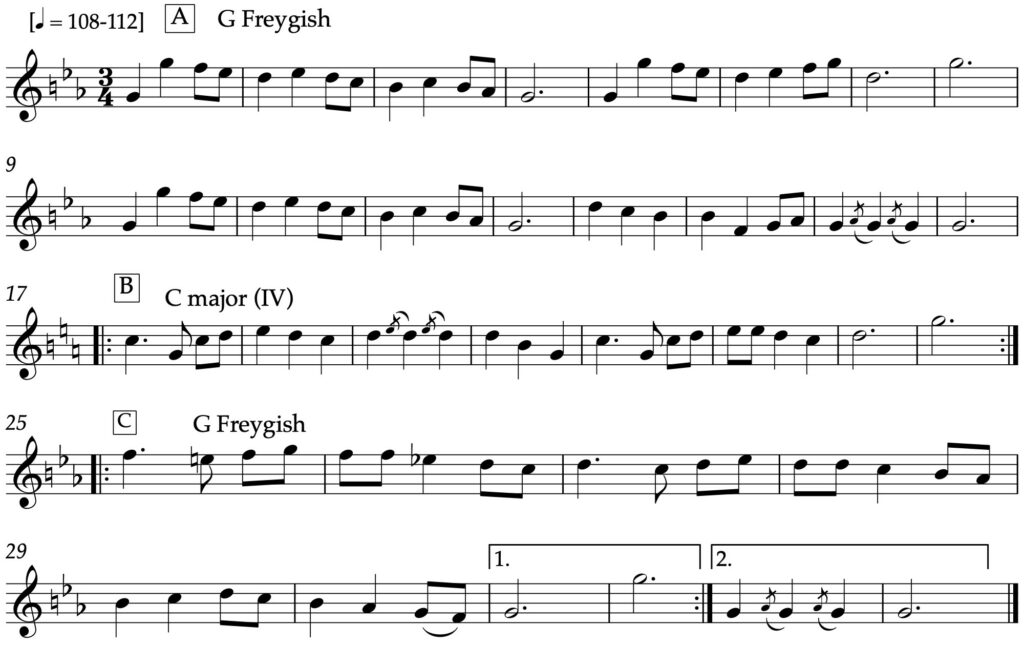
The melody begins not in a major or minor key, but in one of modes that are common in Eastern European music. The key signature includes B♮ along with E♭ and A♭, and the melody centers on G. Klezmer musicians call this mode “freygish”; some readers may recognize it as a “Phrygian-ish.” (It is like the Phrygian mode with a raised third scale degree.) The tune is notated and played here in “G-freygish”; G is the stable resting pitch at the ends of phrases and sections.
We can ask, then, if a tune is in G freygish, where is it likely to go? What are the probabilities for shifts other keys or modes in this style? Are there predictable pathways, like the one from G major to D major in Bach and Mozart, or like the phrases “stay strong/safe/tuned/warm” in American English?
The tune above modulates to C major in the second section. One can hear a shift to major at 1:05 on track 9 from the Ezekiel’s Wheels Klezmer Band album. The notated chart has a new key signature in measure 17 and it uses the notes of the C major scale in measures 17–24. C is the fourth note in the G freygish scale, so we can represent this as a shift to “major IV” (a major key on the fourth scale degree).
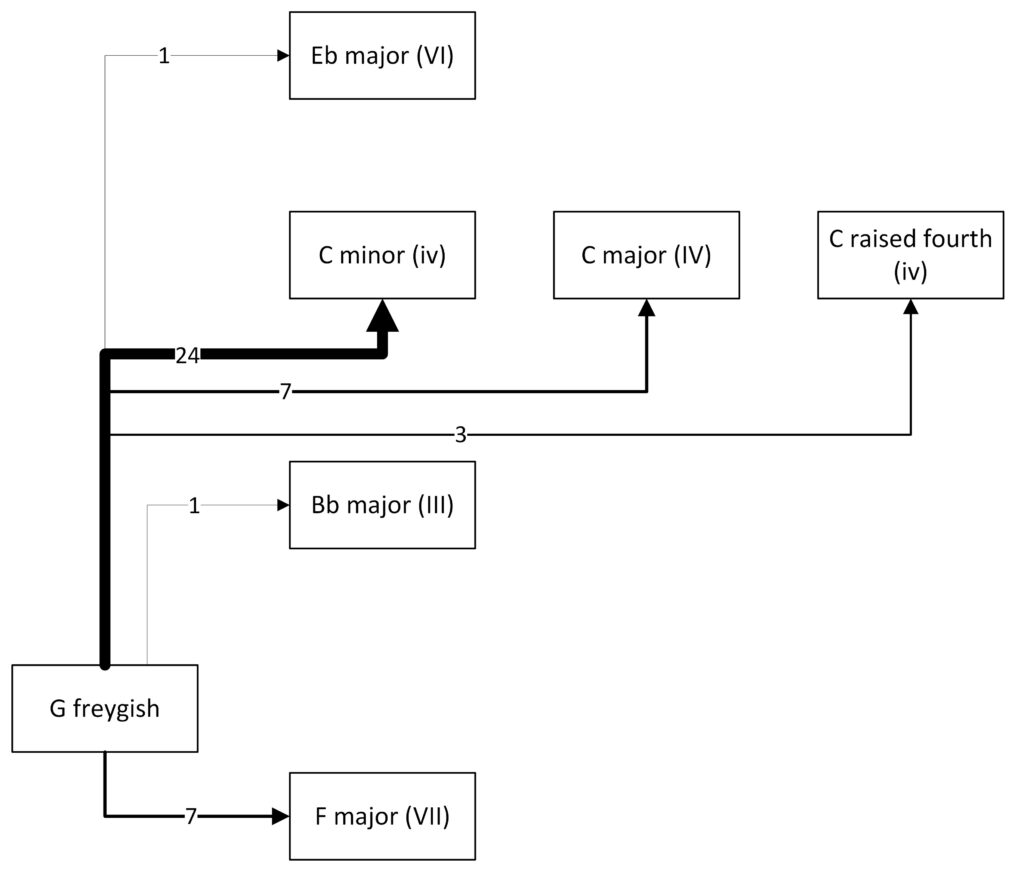
I recently completed a study of 249 tunes from Beregovski’s collection of Jewish instrumental folk music together with Daniel Shanahan from Northwestern University. The diagram below shows the initial modulations for tunes that begin in the freygish mode. Darker lines represent more common modulations, and the numbers show how many tunes follow a given pathway. The most common move is to C minor (iv); after that we find a good number of tunes that modulate to C major (IV) and F major (VII).
This may seem to be primarily of interest for music theorists, those who want to understand the inner workings of musical styles just as linguists and AI programs model languages. But it also has practical applications. If I am sitting in on a klezmer jam session (as I was last month at the Yiddish New York festival) and a musician introduces this tune (as I did), those who know that the move to major IV is a common option will be able to pick up the tune faster by ear. It’s a beautiful tune; I recommend it to anyone interested in learning some klezmer! And if you are sitting around on a cold winter day and someone plays you something in the G freygish mode, you can respond with material in C major before putting on a sweater to stay safe. Oh, sorry, I meant stay warm!
References
Beregovski, Moshe. 2015. Jewish Instrumental Folk Music: The Collections and Writings of Moshe Beregovski. Second edition, revised by Kurt Bjorling. Draft 3.4. Edited by Mark Slobin, Michael Alpert, and Robert Rothstein.
Ezekiel’s Wheels Klezmer Band. 2016. Turning Point. EWKB-0003.
Malin, Yonatan, and Daniel Shanahan. 2025. “Modes in Klezmer Music: A Corpus Study Based on Beregovski’s Jewish Instrumental Folk Music.” Music Theory Online 31 (3). https://www.mtosmt.org/issues/mto.25.31.3/mto.25.31.3.malin.html
—Yonatan Malin
Upcoming Colloquia (academic presentations)
We invite you to these College of Music Musicology and Music Theory Colloquium talks. Free & open to the public! All events are held in room S101 in the Imig Music Building, 2:30 – 3:30 p.m. Refreshments provided.
Monday, February 23: Kim Goddard Loeffert (Virginia Tech), “Vignettes in Musical Analysis, AI, and Universal Design”
This lecture presents a series of analytical and methodological vignettes drawn from recent work at the intersections of musical analysis, artificial intelligence, and pedagogy. Short case studies are used to surface shared questions about modeling, analytical practice, and disciplinary boundaries.
The lecture opens with an analytical reading of Kansas Rapture for saxophone quartet by Forrest Pierce, using topic theory to examine a contemporary work written for a familiar yet analytically under-theorized ensemble. It then turns to Taylor Swift’s “Blank Space,” drawing on Nicole Biamonte’s (2018) work on rhythmic functions in popular music. These two analyses serve as entry points into broader collaborative work with John Peterson (James Madison University) on Modeling Musical Analysis (Oxford University Press, 2025) and its successor project, Modeling Popular Music Analysis (in progress).
The latter portion of the lecture shifts from analysis to AI, copyright, and pedagogy. Drawing on collaborative work with Emmett O’Leary (University of Tennessee, Knoxville), the lecture addresses current debates about how analytical, pedagogical, and creative uses of AI complicate existing legal and ethical frameworks. The lecture concludes with practical reflections on AI and Universal Design for Learning (UDL), sharing ways that AI tools can support accessibility in course design and assessment.
Monday, March 2: Wendy Heller (Princeton)—“Performing Dissimulation in Jingju: Mei Lanfang and the Cross-Cultural Aesthetics of Feigned Madness”
The climax of the Jingju (Peking Opera) entitled Yuzhou feng (Cosmic Blade) features a familiar operatic convention: Zhao Yanrong, a young widow, feigns madness before her father to avoid being forced to becoming the emperor’s concubine. This was Mei Lanfang’s favorite role because it demanded that he display multiple emotions in close succession—Zhao’s true feelings, the appearance of madness, while also expressing the “incommunicable suffering” of her inner psyche. Mei’s observations about multilayered expression recall descriptions of Anna Renzi’s renowned performance in Francesco Sacrati and Giulio Strozzi’s La finta pazza (Venice, 1641). While operatic mad scenes typically push rhetorical boundaries, exposing the musical or gestural limits in any given style, feigned madness requires the protagonist to both dissimulate and perform dissimulation. Claudio Monteverdi’s novel aesthetics of feigned madness, described in a famous series of letters, challenged the fundamental premise of the new genre, envisioning an innovative form of musical mimesis in which words—rather than being the mistress of the music— were severed from semantics and affect. The convention is no less subversive in Yuzhou feng, where Lanfang’s rendition of Zhao’s feigned mad scenes extends the highly controlled musical and dramatic conventions that are central to the performance of dan roles in Peking Opera.
After a brief consideration of feigned madness in on the early modern European stage, my paper explores Mei’s virtuosic interpretation of Zhao Yanrong’s feigned madness in Cosmic Blade as captured in the film of the opera, focusing on the musical, gestural, and narrative markers of a simulated insanity, considering both the visual manifestations of the pretense (self-mutilation, auditory hallucinations, and erotomania) and the musical markers of insanity (excessive ornamentation, registral extremes, melodic distortions), which illuminate the norms of the genre, especially with regard to female deportment. I conclude with a consideration of the representation of both feigned and genuine madness in the Shanghai Peking Opera Company’s production of The Revenge of Prince Zi Dan, an adaptation of Shakespeare’s Hamlet, which illuminates some of the similarities and differences in the European and Sinitic approach to theater. In the end, there is a method to madness.
Monday, March 30: Daphne Leong (CU Boulder), “What Counts as Meter?”
This presentation challenges assumptions of prominent theories of meter, to wit, preferences for isochrony and measurement, for sound as indicative of meter, and for meter as a mode of attending. Motivated by examples that range across folk song and dance, popular and improvised music, and notated art music, and that represent the creation of meter as well as its reception, the presentation proposes a broader view of what meter might be. This view is theorized with multi-level, potentially metrical systems comprised of timepoint series in varied temporal spaces. The timepoint formalization is balanced with theories of meter as continuous motion, and the viewpoint as a whole is set in the context of cross-cultural studies and cultural neuroscience.
Monday, April 6: Takako Fujioka (Stanford), “How We Deal with Musical Timing: Beat and Meter, Tempo Change, and Plasticity”
We rely on a sense of time to plan and play music. It requires organizing representations between internal and external timing processes for successful prediction, real-time monitoring, and adjustment. Using simple metronome listening tasks, my research has shown that an internal sense of beat and meter, and the anticipation of upcoming tempo changes, are represented in the brain in a distributed manner. I will explain how these timing processes involve the auditory cortex and motor system areas, and how beat-related neural activities enhance motor excitability and show training effects in older adults and chronic stroke survivors. Furthermore, I will discuss a recent study examining how individuals differ in their sense of beat when listening to multiple metronomes that are loosely aligned.
Monday, April 13: Tal-Chen Rabinowitch (University of Haifa), “Impacting Social Interactions through Music and Interpersonal Synchrony”
A growing body of research highlights the potential of music and interpersonal synchrony to enhance social and emotional interactions. Musical interaction—particularly when individuals collaboratively make music—has been linked to increased group cohesion, cooperation, and emotional empathy. Similarly, interpersonal synchrony, where individuals coordinate their movements or actions, has been shown to foster social bonding, trust, and emotional connection. These positive outcomes are well-documented, and understanding the underlying mechanisms offers valuable insights into their broader social significance. However, despite the extensive literature on their benefits, relatively few studies address potential negative consequences associated with musical engagement and synchrony. Concerns include the possibility of fostering blind obedience, conformism, reduced creativity, or even aggression toward out-group members under certain conditions. This duality suggests that musical and rhythmic interactions may not be inherently beneficial but are influenced by contextual and sociocultural factors. In this talk, I will explore the theoretical frameworks explaining the mechanisms behind these dual outcomes, integrating sociological perspectives to elucidate how and when music and synchrony promote positive or negative social effects. I will present empirical evidence supporting these notions, including recent preliminary data from ongoing experiments in my lab. These findings contribute to understanding the conditions that enhance the beneficial impacts of musical and rhythmic engagement on social cohesion while mitigating potential drawbacks.
ABOUT THE MUSIC THEORY DEPARTMENT AT THE UNIVERSITY OF COLORADO BOULDER
Our faculty are Mark Arnett, Karin Buer, Philip Chang, Leah Frederick, Daphne Leong (chair), Yonatan Malin, and Keith Waters.
Visit the department home page for more information.
Header image by Rok Romih.

